Optimize
Cholesterol test

Get your cholesterol measured

Cholesterol measurement is included by default in the Optimize Baseline blood test: not just total cholesterol, but LDL, HDL, ApoB, triglycerides and all the important ratios. No add-on, no doctor's referral. Clear per-marker explanations in the app.

Get your cholesterol measured
01 Panel
0+
cholesterol values in the Baseline
02 Reach
0+
draw locations in the Netherlands
03 Access
No
referral needed
01 Panel

Which cholesterol values are in the Baseline?

Total cholesterol is a coarse number — on its own it says little. The real lipid profile is the combination of LDL, HDL, ApoB, triglycerides and the ratios between them. All of those values are included by default in the Optimize Baseline blood test; below we explain each marker individually.

02 Frequency

How often should you measure your cholesterol?

If your values are stable and you have no elevated risk, once every 1 to 2 years is enough. Adjusted your nutrition, training or supplements? A re-test after 8 to 12 weeks already shows clear movement — LDL and triglycerides respond quickly to lifestyle.

Some markers, like ApoB and Lp(a), are largely genetic and need less frequent repeats. They do give a crucial baseline of your cardiovascular risk.

03 Access

Where can I get my cholesterol measured?

With Optimize you book the appointment yourself and draw at one of the 238+ locations near you, without a doctor's referral. Your values appear in the Optimize app within days, with explanations per marker and context from your full blood work.

For accurate triglycerides, fasting (8-12 hours) is recommended. The app shows exactly how to prepare for your appointment.

Markers explained

What does each cholesterol marker measure?

Seven values, each with a different meaning for your heart health — plus one genetic add-on.

Total cholesterol

The sum of LDL, HDL, VLDL and other cholesterol fractions. Useful as a starting point but misleading as the only measure: high totals can result from high HDL (favourable) and high LDL (unfavourable) combined. Always interpret alongside the other markers.

LDL cholesterol

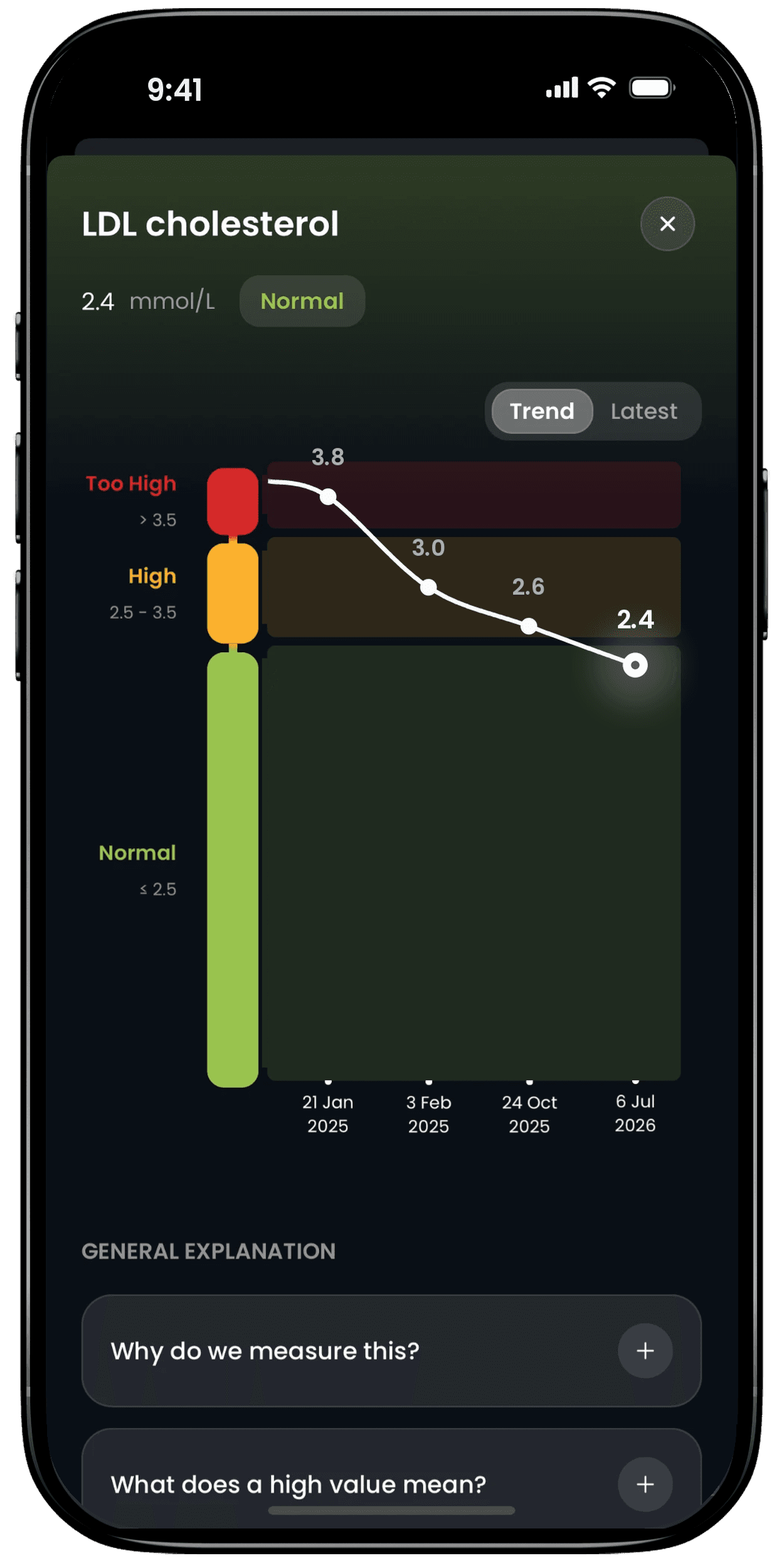
Low-density lipoprotein carries cholesterol from the liver to the tissues. Too much LDL promotes plaque build-up in the arteries (atherosclerosis). LDL responds well to lifestyle: less saturated and trans fat, more soluble fibre and aerobic exercise lower it measurably.

HDL cholesterol

High-density lipoprotein transports cholesterol back to the liver for breakdown — hence the "good" label. The higher the HDL, the better the protection. Aerobic training (running, cycling, swimming) and omega-3 fatty acids raise HDL most effectively.

Apolipoprotein B (ApoB)

ApoB is the protein on the outer wall of all atherogenic particles: LDL, IDL, VLDL and Lp(a). A single ApoB measurement counts all dangerous particles — not just their cholesterol mass. That makes ApoB a more precise risk indicator than LDL, especially in people with high triglycerides or insulin resistance.

Triglycerides

Fats circulating in the blood as energy reserves. Triglycerides rise with excess refined carbohydrates, alcohol, overweight and inactivity. High fasting triglycerides are an independent cardiovascular risk factor. Good news: they respond strongly to lifestyle changes within weeks.

TC / HDL ratio

The ratio between total cholesterol (TC) and HDL. The lower the ratio, the greater the proportion of "good" cholesterol. Target value: below 4.0. Useful as a quick risk summary, but less specific than ApoB.

LDL / HDL ratio

The direct comparison between atherogenic LDL and protective HDL. Target value: below 3.0. Falls with every combination of LDL reduction and HDL increase — precisely what an active lifestyle achieves.

add-on
Lipoprotein(a) — Lp(a)

Lp(a) is a special lipoprotein particle with an extra protein (apolipoprotein(a)) that makes it particularly "sticky" and interferes with blood clotting. High Lp(a) levels substantially raise the risk of heart and vascular disease — independently of LDL or lifestyle. Levels are ~90% genetically determined and barely respond to diet or exercise. Testing once for a baseline reference is valuable; large changes on re-testing are not expected.

Ready to get your cholesterol measured? Start the Baseline blood test in the Optimize app. Cholesterol measurement is included.

Get your cholesterol measured

What's all in the Baseline?

Your cholesterol is part of the full lipid profile — included in the same Baseline blood test that maps your whole body. Here's what you get as standard:

Immune system
7 biomarkers
Oxygen transport
9 biomarkers
Organs
17 biomarkers
Hormones
2 biomarkers
Nutrients
8 biomarkers
Beyond the baseline
Follow-ups & add-ons

Beyond the baseline there are deep-dive tests and add-ons for specific questions.

See the full blood test
Standard cholesterol test vs Optimize

What you get that a standard cholesterol test misses.

GP
Optimize
Total cholesterol
LDL cholesterol
HDL cholesterol
Triglycerides
Apolipoprotein B (ApoB)
Cholesterol / HDL ratio
LDL / HDL ratio
Per-marker explanation
Every marker
Trend over time
Built in

Clarity on your heart and vascular health

Cholesterol measurement is in the Baseline. No add-on.
Includes ApoB and all ratios
Track your values over the years
Total cholesterolLDL cholesterolHDL cholesterolApolipoprotein BTriglyceridesTotal cholesterol / HDL ratioLDL / HDL ratioGlucoseHemoglobin A1cC-reactive proteinHomocysteineALTASTGamma-glutamyltransferaseCreatinineeGFRTSHFree T4Total cholesterolLDL cholesterolHDL cholesterolApolipoprotein BTriglyceridesTotal cholesterol / HDL ratioLDL / HDL ratioGlucoseHemoglobin A1cC-reactive proteinHomocysteineALTASTGamma-glutamyltransferaseCreatinineeGFRTSHFree T4Total cholesterolLDL cholesterolHDL cholesterolApolipoprotein BTriglyceridesTotal cholesterol / HDL ratioLDL / HDL ratioGlucoseHemoglobin A1cC-reactive proteinHomocysteineALTASTGamma-glutamyltransferaseCreatinineeGFRTSHFree T4
Free T4TSHeGFRCreatinineGamma-glutamyltransferaseASTALTHomocysteineC-reactive proteinHemoglobin A1cGlucoseLDL / HDL ratioTotal cholesterol / HDL ratioTriglyceridesApolipoprotein BHDL cholesterolLDL cholesterolTotal cholesterolFree T4TSHeGFRCreatinineGamma-glutamyltransferaseASTALTHomocysteineC-reactive proteinHemoglobin A1cGlucoseLDL / HDL ratioTotal cholesterol / HDL ratioTriglyceridesApolipoprotein BHDL cholesterolLDL cholesterolTotal cholesterolFree T4TSHeGFRCreatinineGamma-glutamyltransferaseASTALTHomocysteineC-reactive proteinHemoglobin A1cGlucoseLDL / HDL ratioTotal cholesterol / HDL ratioTriglyceridesApolipoprotein BHDL cholesterolLDL cholesterolTotal cholesterol

How to get your cholesterol measured

01 Download
Download the app
Create a free Optimize account and set heart and vascular health as your focus.
02 Pick
Pick your panel
Start with the Baseline for a broad reading including the full lipid panel, or pick a focused heart-health deep-dive.
03 Draw
Book a blood draw
Book an appointment at one of the 238+ locations. For accurate triglycerides: fast for 8 to 12 hours.
04 Understand
Understand your cholesterol values
See where each cholesterol marker stands against optimal ranges, with explanations of what it means.
05 Track
Track change over time
Re-test after 8 to 12 weeks to see how your values shift with your lifestyle.
FAQ

Frequently asked questions

The key things to know about cholesterol testing with Optimize.

Is cholesterol measurement included in the Baseline?

Yes. Total cholesterol, LDL, HDL, ApoB, triglycerides and the cholesterol ratios are all included by default in the Optimize Baseline blood test. No add-on or extra cost needed.

Where can I get my cholesterol measured?
Do I need to fast before the cholesterol test?
What does ApoB actually measure?
What if my cholesterol values are off?

Cholesterol measurement, included in the Baseline.

Book a test whenever it suits you. No add-on, no referral.